
Think Globally
Sustainable aid for tsunami stricken Sri Lanka
During a visit to Sri Lanka for discussions with the Centre for Environment and Development (CED) on establishing an Eco-village grounded in right livelihoods, trustee Owen Fenn and administrator Pip Richards witnessed the 2004 tsunami first-hand — a catastrophe from which they were lucky to escape.

Over the years, we have continued to support in modest but meaningful ways. Thanks to the Saga Charitable Trust, the initiative has expanded to include provision of fruit-bearing trees for displaced families, education on reducing carbon footprints, and the installation of solar power. The Centre for Environment and Development contributed to Advancing Sustainable Consumption in Asia, a guidance manual published by the United Nations Environment Programme (ISBN: 92-807-2639-0).
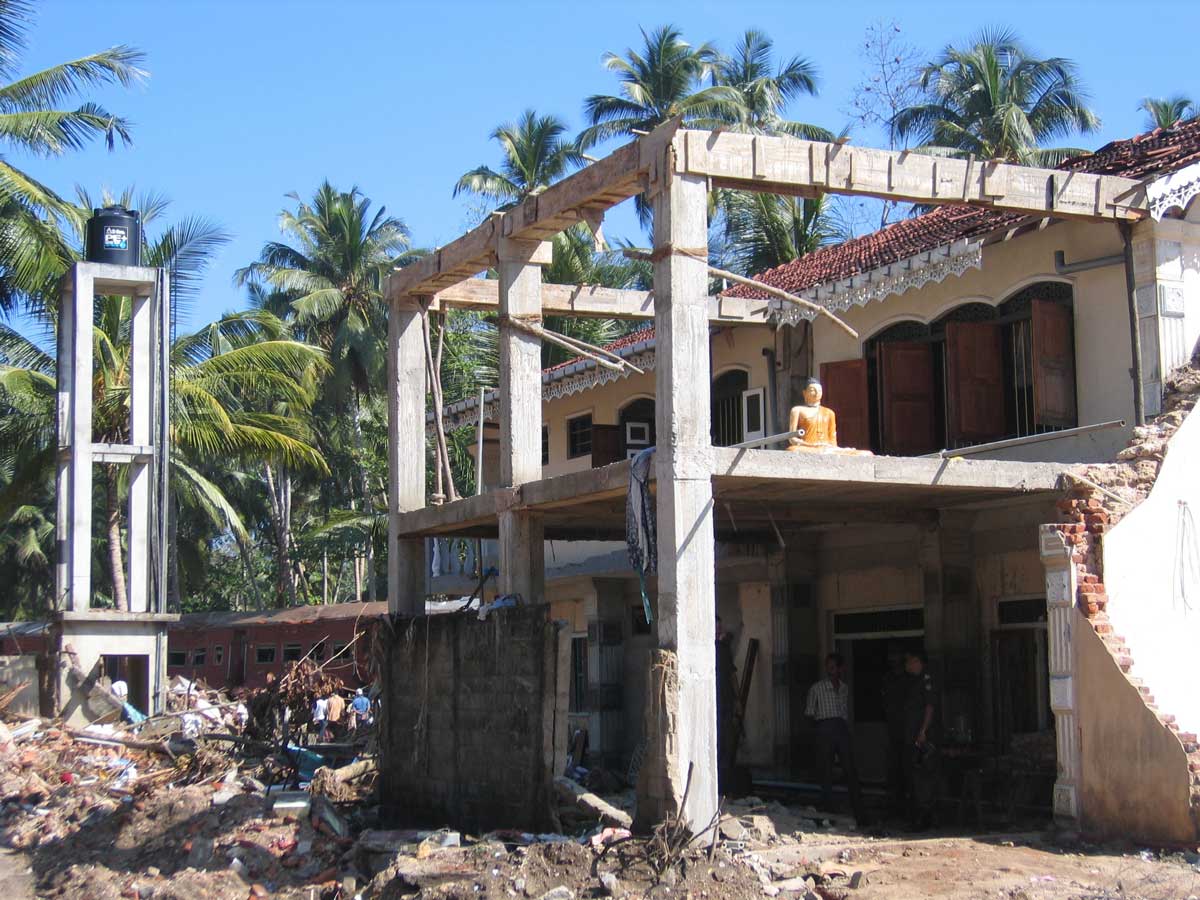
When the waves came in, the lives of coastal villagers were changed within minutes. Alongside the tragic loss of life, homes were destroyed, livelihoods vanished, and a deep, unfamiliar fear settled in. The train at Peraliya, on the south-west coast, was swept away, killing 1,700 people. Within days, aid arrived from across the developed world, focused largely on this site.
Pip and Joe of Sustrust found refuge in the jungle near the affected region. They were cared for with generosity and joy by a devastated community — an experience that moved them to return with help when the time was right. The Sustainable Trust raised £4,000, with support from Cornish green businesses, local groups and individuals including Robotmother (carbon neutral developers), Helston and the Lizard Friends of the Earth, Cornwall Paper Company, Ground Force cycling group, the Longmead Trust, and local food producers. All travel and living costs were covered personally. Together with our partners in Colombo, we worked to improve the conditions and wages of coir workers in a single village, guided by what could be achieved with this modest sum.
Through this work, a deeper need became clear. The villagers, disheartened and divided, had lost their sense of community. A house abandoned after the tsunami was identified as a potential centre for reconnection. With encouragement from CED, youth, children and elders came together to clear the garden, lay water pipes, and sand and paint the wave-damaged house. It is now a thriving development centre.
Accomplishments:-
- A Village Council has been created
- Water storage and distribution have been improved
- The Coir industry has been revived, alongside a micro-credit system
- A Youth and Sports Development Club has been formed
- 50 children joined the Better World Children’s Club and opened bank accounts
- Three families received small grants to complete their homes
- An Entrepreneur Programme was launched, supporting a TV and electronics repair shop, an electrical workshop and a small tailor’s shop
- The Community Development Centre was cleaned, repaired, and fitted out with 50 chairs, a library and first aid facilities
- A ‘World Environment Day’ celebration was held with tree planting and guidance on home gardening
- At a nearby college, funds from the Saga Charitable Trust helped repair the tsunami-damaged gate. This college provided shelter for 5,000 people in the days following the disaster


